Web Test Automation
PlaywrightCypressSelenium WebDriverWebdriverIOPuppeteerTestCafe


Quality assurance inserted at the end of a development program does not produce quality software. It produces software with documented defects and a compressed timeline for fixing them. OpenTeQ Quality Engineering practice embeds quality at every stage of the software development lifecycle, from requirements validation through architecture review, continuous automated testing, and production monitoring.


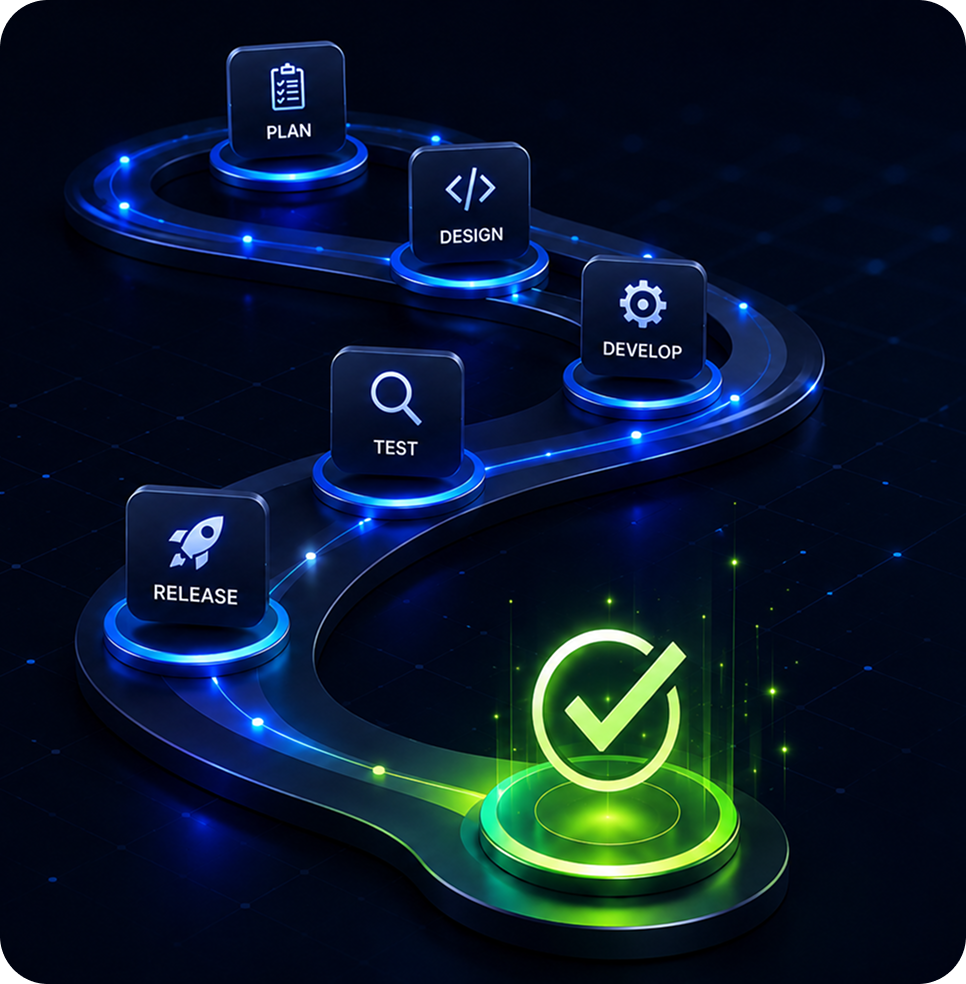
Quality Is Not a Gate at the End. It Is the Architecture of Everything Before It.
Most technology programs treat quality as a final checkpoint, a review that happens after the build, a test cycle squeezed into the last two weeks of a sprint, a sign-off that happens before go-live and nothing more. At OpenTeQ, quality is an engineering decision made at initiation and honored at every stage that follows. It is defined in the architecture. It is planned into the scope. It is executed in the sprint. It is measured at every milestone gate and it carries forward into how the solution operates in production, long after delivery is complete.
Our OQ Standard governs quality across three dimensions simultaneously: Quality of Outcome ensures every deliverable performs against the business requirement it was built for; Quality of Intelligence ensures the solution improves with every operational cycle, every data input, and every user interaction; Quality of Trust ensures the security, compliance, and governance controls your environment demands are embedded by design not added as an afterthought.
The result is a delivery model where quality does not slow velocity it is what makes velocity sustainable. Every release that leaves our teams is operationally qualified, production-proven, and built to compound in value from the moment it goes live.
Consciously embed quality from day one with OpenTeQ AI-first engineering practice, delivering continuous quality assessment across reliability, performance, and security throughout your entire Agile delivery lifecycle.
Adopt intelligent, scalable automation frameworks that leverage AI prediction capabilities to accelerate testing cycles, improve coverage, and surface quality metrics in real time, giving your teams rapid, data-driven feedback at every sprint.
Experience structured functional validation aligned with Agile delivery rhythms, consciously verifying business logic, user journeys, and acceptance criteria from sprint one, so quality is never an afterthought.
Embed proactive security assurance early in your delivery pipeline with AI-assisted vulnerability detection, penetration testing, and compliance validation, treating application integrity as a continuous quality metric, not a final checkpoint.
Harness AI prediction capabilities to model load, stress, and scalability thresholds before they become production incidents, assuring your applications sustain best performance under any real-world demand scenario.
Validate API reliability, security, and performance continuously across Agile delivery cycles, leveraging automated quality models to maintain seamless integration, consistent data exchange, and measurable contract compliance.
Deliver flawless mobile experiences by applying Quality 4.0 approaches across devices, OS versions, and network conditions with continuous quality assessment that surfaces coverage gaps before your users ever encounter them.
Implement AI-augmented test automation frameworks that consciously support continuous delivery pipelines, enabling measurable improvements in test coverage, cycle time, and release confidence through strong, self-maintaining test suites.
Validate machine learning models and intelligent systems with purpose-built quality models that assess accuracy, bias, performance, and ethical compliance, making sure your AI outputs meet both technical and responsible AI standards.
Certify data correctness, completeness, and pipeline performance across big data ecosystems using continuous quality assessment and IoT sensor-integrated validation, ensuring your analytics and ETL workflows deliver trustworthy, audit-ready outputs.
Apply Quality 4.0 approaches to test smart contracts, agreement mechanisms, and distributed ledger systems, leveraging blockchain for traceability and integrating continuous quality assessment to validate security, performance, and functional correctness.
Consciously de-risk cloud migrations with AI-assisted quality models that continuously assess functionality, performance, security, and data integrity, guaranteeing each migrated workload meets defined quality metrics before and after go-live.
Apply a comprehensive, AI-first security assurance program that integrates vulnerability assessments, penetration testing, and compliance validation into your Agile delivery lifecycle, treating security as a continuous quality metric from day one.
Experience end-to-end IoT ecosystem validation powered by Quality 4.0 approaches, integrating IoT modules, AI predictive functions, and traceability mechanisms to assess connectivity, interoperability, security, and performance spanning every device and environment.
Consciously cover every mobile platform, device profile, and network condition with AI-augmented testing strategies, delivering continuous quality assessment that secures consistent, high-performance mobile experiences across your entire user base.
Validate robotic process automation workflows with precision quality models that assess accuracy, resilience, and exception handling, consciously making sure your automated business processes perform reliably within Agile delivery frameworks.
Adopt a Quality 4.0-aligned assurance approach for ERP, CRM, and custom enterprise systems, integrating continuous quality assessment, AI predictive functions, and end-to-end traceability to safeguard reliability, integration integrity, and uninterrupted business continuity.
We operate across the modern QE tooling landscape — commercial platforms, open-source frameworks, and increasingly AI-native testing tools. Pick the right tool for the workload, not the one we happen to resell.
OpenTeQ QA and Testing Services form the foundational layer of our Quality Engineering practice, delivering structured, expert-led testing across every release milestone. Our QA practitioners combine domain knowledge with testing discipline to validate that every application performs as specified, meets business requirements, and reaches production in a state your stakeholders can sign off on with confidence.
Experienced QA engineers who understand your business context, user expectations, and the edge cases that automated testing alone cannot reliably cover.
End-to-end functional validation confirming every feature, workflow, and business process performs exactly as specified across every supported environment and configuration.
Structured UAT support that helps business stakeholders validate delivered software against their requirements before production sign-off.
Risk-based regression strategy that protects against unintended side effects at every release without the overhead of full test suite execution on every build.
End-to-end test planning, test case management, defect tracking, and quality reporting giving technology and business leadership complete visibility into quality status at every delivery stage.
On-demand, scalable QA capability delivered as a flexible engagement model giving enterprises access to expert testing resources without the overhead of building and maintaining an in-house QA team.
Accelerate release cycles with our automatically generated test cases that minimize manual effort.
Adapt to UI changes automatically with tests that eliminate costly maintenance and reduce flaky failures.
Avail specialized frameworks to validate non-deterministic AI outputs that traditional testing methods can't assess.
Make the most of our Industry-aware testing tailored to the compliance needs of Insurance, Banking, Healthcare, and Life Sciences.
Experience quality embedded from day one of development, catching defects earlier and reducing rework costs.
Optimize with our Talent-as-a-service offering, which provides flexible team structures that scale up or down based on your timelines and budget.
From Insurance to Healthcare to Banking, OpenTeQ Technologies engineers' quality that meets your industry's highest standards.
Scale with our Talent-as-a-Service model, which lets you hire skilled professionals with expertise in modern testing tools, methodologies, and best practices.
Flexible Engagement
Full-time, part-time, or contract
Quick Onboarding
Start within 2 weeks
Vetted Talent
Pre-screened experts